
Forex trading is the buying and selling of currencies through currency pairs such as EUR/USD, USD/JPY or GBP/USD. In Vietnam, beginners usually start by learning how the forex market works, opening a demo or small live account, understanding spreads and leverage, and choosing trading sessions that match their risk tolerance.
Forex can be accessible because it is traded online and operates across global financial centres during the business week. However, forex trading is not simple just because the market is open almost all the time. A beginner needs to understand how prices move, how trading costs affect results, and how leverage can magnify both gains and losses.
This guide explains what forex trading means, how the foreign exchange market works, how Vietnamese traders can approach online forex trading, and what to check before opening a forex trading account. The goal is to help beginners make more informed decisions before trading real money.
What Is Forex Trading?
Forex means foreign exchange. Forex trading is the process of buying one currency while selling another currency at the same time. Every forex trade uses a currency pair, and the exchange rate shows how much of the quote currency is needed to buy one unit of the base currency.
For example, in the EUR/USD pair, EUR is the base currency and USD is the quote currency. If a trader buys EUR/USD, the trader expects the euro to strengthen against the US dollar. If a trader sells EUR/USD, the trader expects the euro to weaken against the US dollar.
The forex market is not a single centralized stock exchange. Forex is an over-the-counter market where banks, brokers, financial institutions, companies and traders exchange currencies through electronic networks. This structure is why the forex market can operate across multiple time zones from Monday to Friday.
How Big Is the Forex Market?
The forex market is the largest financial market by turnover. The Bank for International Settlements reported that trading in over-the-counter foreign exchange markets reached $9.6 trillion per day in April 2025, up from $7.5 trillion three years earlier. Spot FX turnover accounted for $3 trillion per day, or 31% of global FX turnover.
The US dollar remains the dominant currency in global forex trading. BIS reported that the US dollar was on one side of about 89% of all foreign exchange trades in April 2025. This is one reason why many beginner-friendly currency pairs include USD, such as EUR/USD, GBP/USD and USD/JPY.
Large market size does not mean easy profit. High liquidity can help reduce spreads and improve execution in active market conditions, but a trader can still lose money if position size, leverage, stop-loss placement or emotional discipline is poorly managed.
How Forex Trading Works in Vietnam
Forex trading in Vietnam usually happens through an online forex broker or trading platform. A trader opens a trading account, chooses a platform such as MetaTrader 4 or MetaTrader 5, selects a currency pair, decides whether to buy or sell, and manages the position with risk controls such as stop-loss and take-profit orders.
Vietnam-based traders should think about both market mechanics and trust checks. The State Securities Commission of Vietnam has published investor warnings about unlicensed trading floors and online investment platforms. For retail traders, the practical takeaway is simple: verify the company, check the trading terms, avoid guaranteed-return claims, and understand the risk disclosure before depositing funds.
A beginner should not treat forex trading as a shortcut to income. Forex trading is a market activity that combines price analysis, risk management, trading psychology, platform knowledge and cost control. A demo account can be useful before moving to real funds because it lets traders practice order placement and risk settings without financial exposure.
Forex Currency Pairs Explained
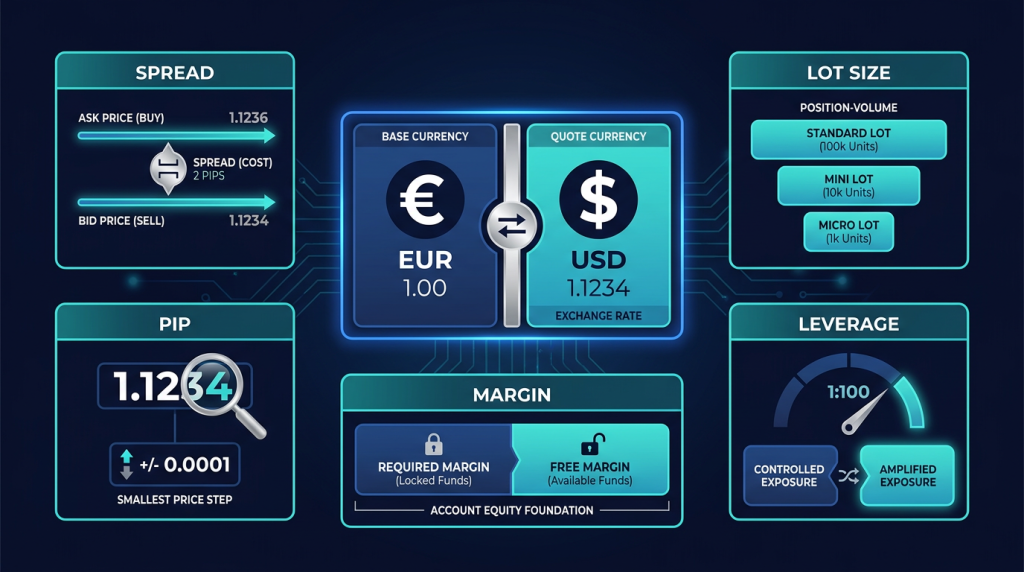
A currency pair shows the value of one currency compared with another. The first currency is the base currency, and the second currency is the quote currency. The pair type affects liquidity, spread, volatility and beginner suitability.
| Pair type | Examples | Beginner note |
|---|---|---|
| Major pairs | EUR/USD, GBP/USD, USD/JPY, USD/CHF | Usually more liquid and often tighter-spread than other pair types. |
| Minor pairs | EUR/GBP, EUR/JPY, AUD/NZD | Can be useful, but liquidity and volatility vary by pair. |
| Exotic pairs | USD/ZAR, USD/MXN, USD/SGD | Usually more advanced because spreads and volatility can be higher. |
For most beginners, major pairs are usually easier to study first because they tend to have deeper liquidity and more available educational material. Exotic pairs may look attractive because they move strongly, but wider spreads and sudden price swings can make risk control harder.
How to Start Forex Trading for Beginners
Learning how to start forex trading is not only about opening an account. A beginner should build a process before placing live trades.
- Learn basic terms: currency pair, pip, spread, lot, leverage, margin, stop-loss and take-profit.
- Study how economic news, interest rates and risk sentiment affect currencies.
- Open a demo account and learn how the platform works.
- Choose a small watchlist of liquid pairs instead of trading every market.
- Create a simple trading plan with entry, exit and risk rules.
- Decide how much of the account can be risked per trade before opening a position.
- Start with small live exposure only after the platform and strategy are tested.
- Review each trade to understand whether the result came from plan quality or emotion.
Forex Trading Account and Platform
A forex trading account and a trading platform are not the same thing. The account is provided by the broker and contains the account currency, balance, instruments, margin rules and trading conditions. The platform is the software interface where the trader views charts, places orders and monitors positions.
MetaTrader 4 and MetaTrader 5 are commonly used forex and CFD trading platforms. A trader can download a platform, but trading still requires valid account credentials and the correct broker server. If the server, login or password is wrong, the platform may open but the account will not connect properly.
For a JustMarkets product bridge, the Standard account page lists MT4/MT5 access, a $10 minimum deposit, spreads from 0.3 pips, no commission, account currencies including VND, maximum leverage up to 1:3000, swap-free availability and a minimum lot size of 0.01. These are trading conditions, not a guarantee of trading results. High leverage should be treated as risk exposure because it can magnify both gains and losses.
Pips, Spreads, Lots and Trading Costs
A beginner who understands trading costs can make better decisions. Even a correct market direction can produce a weak result if the spread, commission, swap, slippage or position size is not considered.
| Term | Meaning | Why it matters |
|---|---|---|
| Pip | A small price movement in many currency pairs. | Used to measure price movement and calculate trading results. |
| Spread | The difference between the bid and ask price. | Often the main cost on spread-based forex accounts. |
| Lot | The position size used for a forex trade. | Controls how much each pip is worth in money terms. |
| Commission | A direct trading fee, if charged by the account type. | Adds to total cost and affects net performance. |
| Swap | An overnight financing adjustment. | Matters when positions are held after the trading day changes. |
| Slippage | The difference between expected and executed price. | Can happen during news, gaps or fast-moving markets. |
What Is Leverage in Forex?
Leverage allows a trader to control a larger market position with a smaller amount of margin. This can make forex accessible to smaller accounts, but leverage does not make trading safer. Leverage magnifies both potential profit and potential loss.
For example, a highly leveraged position can lose money quickly if price moves against the trader. If losses reduce account equity too much, the trader may face a margin call or stop-out, depending on the broker’s rules. This is why beginners should think in terms of effective risk per trade, not only the maximum leverage available on the account.
A safer beginner approach is to use small position sizes, set stop-loss levels, avoid overtrading during news, and treat leverage as a risk tool rather than a benefit by itself.
Best Time to Trade Forex in Vietnam
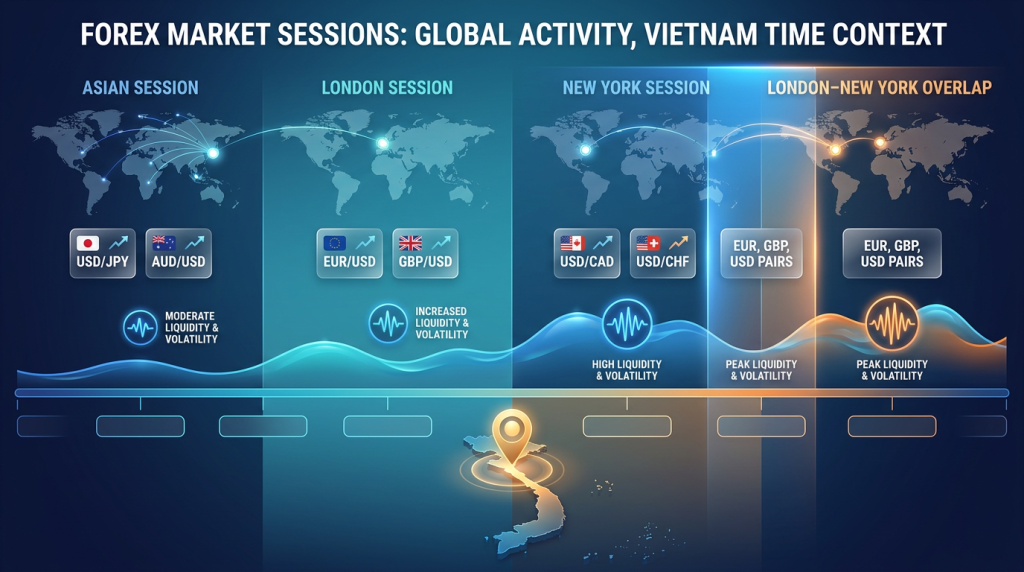
Forex is generally active 24 hours a day, five days a week. JustMarkets lists FX trading hours from Monday 00:02 to Friday 23:59 in server time GMT+3. However, the best time to trade forex in Vietnam depends on the currency pair, spread, volatility, news calendar and trading style.
| Session | Vietnam-time relevance | Beginner note |
|---|---|---|
| Asian session | Fits daytime and early business hours in Vietnam. | Often relevant for JPY, AUD and regional market themes. |
| London session | Starts later in the Vietnam day. | Often brings higher liquidity for EUR and GBP pairs. |
| New York session | Active during evening Vietnam time. | Important for USD pairs and US economic news. |
| London/New York overlap | Happens late for Vietnam-based traders. | Can be more volatile; beginners should manage position size carefully. |
The market being open does not mean every hour is equally useful. Some periods have wider spreads, lower liquidity or stronger news-driven moves. A beginner should pick a session that fits both the trading plan and personal schedule.
Common Beginner Mistakes in Forex Trading
| Mistake | Why it happens | Better approach |
|---|---|---|
| Trading before understanding leverage | Leverage looks like extra buying power. | Treat leverage as risk exposure and calculate possible loss first. |
| Choosing exotic pairs too early | Exotic pairs can look more exciting. | Start with major pairs and learn spread/volatility behaviour. |
| Ignoring spreads | Beginners focus only on direction. | Check bid/ask cost before opening a trade. |
| Trading every session | The market is open 24/5. | Choose sessions that match a clear plan. |
| No stop-loss | The trader hopes price will return. | Define risk before entry and use stop-loss discipline. |
| Following guaranteed-profit groups | Social media can make trading look easy. | Avoid unrealistic return promises and verify claims. |
How to Choose a Forex Broker in Vietnam
A forex broker should be compared by more than marketing claims. The most useful broker comparison checks the account conditions, trading costs, platform access, risk tools and withdrawal process before any deposit is made.
| Factor | Why it matters |
|---|---|
| Legal and entity information | Helps traders avoid fake or clone platforms. |
| Trading costs | Spreads, commissions, swaps and slippage affect net result. |
| Platform access | MT4, MT5, WebTrader and mobile apps affect workflow. |
| Account currency | VND support can simplify local account management for some traders. |
| Demo account | Allows platform testing before live funds are used. |
| Risk tools | Stop-loss, take-profit and margin information support risk control. |
| Withdrawals | Withdrawal conditions matter as much as deposit options. |
| Support and education | Beginners need clear help when account or platform issues appear. |
Forex Trading in Vietnam: Practical Safety Checklist
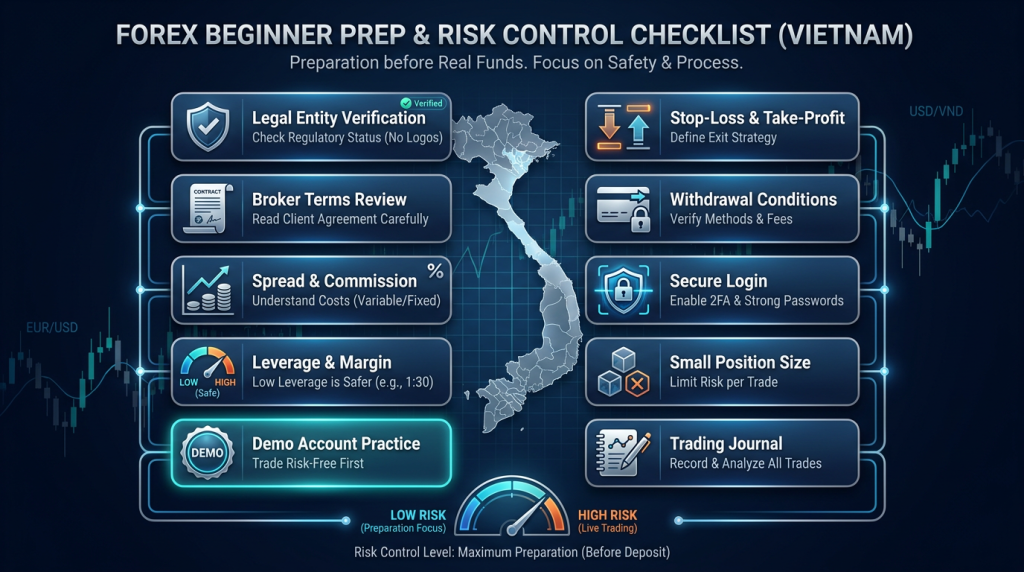
- Check whether the broker or platform clearly identifies its legal entity and terms.
- Avoid groups, signals or platforms that promise fixed income or guaranteed profit.
- Read account conditions before depositing: spread, commission, swap, leverage, margin call and stop-out.
- Test order placement, stop-loss and take-profit on a demo account before live trading.
- Use a small position size when moving from demo to real funds.
- Do not treat bonus, leverage or copy signals as risk-free capital.
- Keep a trade journal so results can be reviewed objectively.
FAQ
1
What is forex trading?
Forex trading is the buying and selling of currencies through currency pairs. A trader buys one currency and sells another at the same time, expecting the exchange rate to move in a favourable direction.
2
How does forex trading work?
Forex trading works through currency pairs, trading accounts and online platforms. The trader chooses a pair, decides whether to buy or sell, sets position size and risk controls, and closes the trade manually or through stop-loss/take-profit orders.
3
Is forex trading suitable for beginners?
Forex trading can be accessible for beginners, but it is risky. Beginners should learn basic terms, use a demo account, control position size and avoid high leverage until they understand how losses can occur.
4
How do I start forex trading in Vietnam?
A beginner in Vietnam can start by learning forex basics, choosing a demo account, testing a trading platform, studying major currency pairs, building a risk plan and verifying broker-related claims before using real funds.
5
What is the best time to trade forex in Vietnam?
The best time depends on the pair and strategy. Asian hours may suit regional pairs, London hours often increase activity in EUR and GBP pairs, and New York hours are important for USD pairs and US news.
6
What is spread in forex?
Spread is the difference between the bid price and ask price. It is one of the main trading costs, especially on accounts that do not charge a separate commission.
7
What is leverage in forex?
Leverage allows traders to control a larger position with smaller margin, but it magnifies both profits and losses. Beginners should treat leverage as a risk factor, not a shortcut to profit.
8
Can I trade forex online?
Yes, forex trading is commonly done online through trading platforms such as MT4 or MT5. Online access does not remove trading risk, so traders should understand costs, leverage and platform settings before trading live.